Sunday, March 10, 2013

Catch a colloid by the tail !

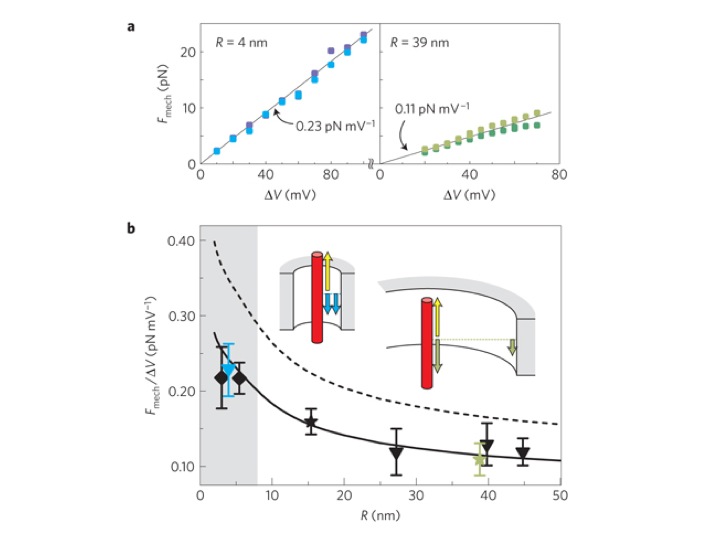
About five years ago, an interesting twist [1] on the resistive pulse technique emerged from the Dekker lab at TU Delft (Netherlands). Their set up is shown in the sketch on the left. One end of the DNA was attached to a polystyrene bead which is held in place by a spot of laser light: a very useful innovation in nanotechnology known as a Laser Optical Trap (LOT) (aka Optical Tweezers). When a voltage is applied and the DNA starts to translocate, the LOT holds it back and "frustrates" the translocation. As the DNA pulls at its tether, the bead is displaced slightly from its equilibrium position which gives a way to directly measure the force acting on the DNA. Instead of yielding the translocation time this method yields the "tether force" together with the conductance change of the pore. This set up can be used to test the idea of the "hydrodynamic origin" of the resistive force discussed in my last Blog. I was able to calculate [2] the tether force using a modification of the theory for translocation times discussed earlier, and this simple analytical formula could be compared with the tether force measurements [3].

This is shown in the panel to the left. The top sub figure shows that the tether force is proportional to the applied voltage. The force per unit applied voltage is plotted in the lower figure against the pore radius (R). The data shows quite clearly the 1/ln R dependence of the force predicted by theory. The dashed curve is obtained if the DNA "bare charge" is used. The solid curve is obtained if the DNA "effective charge" is considered less than the bare charge by a fixed ratio q, considered here as a fitting parameter.


The figure on the right shows a more recent [4] experimental test of the hydrodynamic theory emerging out of the Keyser Lab at the Cavendish.  The Keyser lab has capitalized on an astoundingly simple (= cheap!) way of producing nanopores. They heat a glass microcapillary with a laser and use the traditional glass pulling technique to obtain a sharp tip. Internal diameters of 10-100 nanometers can be obtained in this way. The experiment shows the force signal as a trapped DNA is gradually pulled out of the pore. The force can be calculated using the lubrication theory [5,6] for electrokinetics and is shown by the red dots in the lower panel.

These experiments give us confidence that the principal resistive force in DNA translocation does indeed arise primarily from hydrodynamic drag in the pore region. The challenge now is to use this knowledge to evolve new tools for characterizing DNA such as the base sequence, interactions with proteins and fundamental questions related to the behavior of DNA as a charged polymer. This is still an open book with many exciting possibilities in basic science as well as in nascent technologies. Already, a new term is being used in this context "DNA Force Spectroscopy"!

Acknowledgement:  My research in this area has been supported by the NIH (USA) and by the Leverhulme Trust (UK).

References

[1] Optical tweezers for force measurements on DNA in nanopores (2006) UF Keyser, J van der Does, C Dekker & NH Dekker Rev. Sci. Instruments 77 (10)

[2] Electrokinetic-flow-induced viscous drag on a tethered DNA inside a nanopore (2007) S Ghosal Physical Review E 76 (6), 061916

[3] Origin of the electrophoretic force on DNA in solid-state nanopores (2009) S van Dorp, UF Keyser, NH Dekker, C Dekker & SG Lemay Nature Physics 5, 347 - 351

[4] Single macromolecules under tension and in confinement  (PhD thesis, Cambridge University) Oliver Otto 2011

[5] Lubrication theory for electro-osmotic flow in a microfluidic channel of slowly varying cross-section and wall charge (2002) S Ghosal Journal of Fluid Mechanics 459, 103-128

[6] Electrophoresis of a polyelectrolyte through a nanopore (2006) S Ghosal Physical Review E 74 (4), 041901
 
[7] Effect of salt concentration on the electrophoretic speed of a polyelectrolyte through a nanopore (2007) S Ghosal Physical review letters 98 (23), 238104


Saturday, March 9, 2013

How fast do DNA zip through nanopores?

The resistive pulse technique provides two basic observables from which to infer the properties of the translocating molecule. These are (a) the blockade time (b) the relative conductance change.  The first of these is a measure of the speed (v) of the translocating molecule.

The force driving the translocation is the electrical force acting on the part of the DNA inside the pore. This force is the voltage drop across the membrane times the charge on the polymer within the pore. For typical parameters, this amounts to about 20 pico Newton (pN). Since inertia plays no role at such small scales, to calculate the speed we need to set this driving force to equal a resistive force that will depend on the speed of translocation (v). What is the origin of this resistive force? I made the hypothesis that the resistive force arises primarily from the hydrodynamic drag on the part of the polymer that occupies the pore. The frictional drag from the polymer coil outside the pore as well as the "entropic force" required to straighten the polymer against thermal fluctuations are both small compared to this hydrodynamic drag from the pore. If the primary drag force arose from within the pore, the speed v would be independent of polymer length. This appears to hold to a good approximation from the experimental data.

The hydrodynamic drag on a rod (the DNA) translating through a slightly larger pore (of arbitrary cylindrically symmetric shape) may be calculated using the classical "lubrication theory" of fluid mechanics. In our problem there is some additional physics not encountered in the classical problem and it is this: both the DNA and the wall of the capillary are charged and there is an applied electric field. As explained by Peter Debye all charged macromolecules carry a cloud of mobile counter-ions (positive ions or cations in the case of DNA) that "shield" their electrical interactions with other objects. The electric field acts on these counter-ions to create a body force that drives a jet of fluid upwards through the gap as the DNA moves downwards. This "electroosmotic" effect must be included in the calculation of the drag. Nevertheless, even with this additional effect the problem can be solved and an expression for the velocity obtained in closed form. The graph to the left shows how this formula measures up against the experimental data. The interesting thing about this graph is that it does not involved any "adjustable" parameters even though reasonable approximations (detailed in the papers cited below) need to be made. The upper dashed curve is calculated using the DNA bare charge and the lower curve uses the DNA "effective" charge in accordance with the Manning theory of counter-ion condensation.


References

1. Electrophoresis of a polyelectrolyte through a nanopore S Ghosal (2006) Physical Review E 74 (4), 041901

2. Effect of salt concentration on the electrophoretic speed of a polyelectrolyte through a nanopore (2007) S.Ghosal Physical review letters 98 (23), 238104

Friday, March 8, 2013

(Background) How polymers cross membranes

A cell is enclosed in a lipid bi-layer membrane which serves as a reaction chamber for the biochemical processes of life. Within the cell there are various organelles such as the nucleus, mitochondria and so on which too are surrounded by membranes. In order for the cell to function, some but not all bio-molecules must be able to cross the membrane. This usually happens through proteins that form pores on these membranes. These pores are very small, often a nanometer or so in  size. They serve as border "check points" for the intra-cellular and intra-organelle "traffic".  Many important bio-molecules are long chain polymers e.g. DNA, RNA and proteins. The physical process by which such polymers cross membranes is of importance for understanding how cells function.

As in other areas of science, real insight is often gained by studying an effect in isolation free of the influences of non-essential phenomena. Biologists call this "in vitro" experiments (in vitro = in the test tube as opposed to inside a living organism or "in vivo"). In 1996, Kasianowicz et al. published a very beautiful in vitro experiment that mimicked the natural process of polymer translocation across membranes. A version of the experiment (figure taken from the later paper by Meller et al.) is shown in the left. A natural protein that goes by the name of "alpha-hemolysin" was extracted from the "staph" bacteria Staphylococcus aureus. This protein is a heptamer - it comes in seven parts like Leggo pieces. When the pieces are absorbed on to a lipid membrane, they self assemble forming a pore. In the experimental set-up the lipid membrane formed the partition between two baths containing salt water across which an electric voltage was applied. The assembly of the pore was signaled by the current that would start to flow as soon as a conducting path through the membrane was established. When a small amount of DNA was added to the negative side of the bath, every now and then, the electric field would shoot a DNA molecule through the pore (DNA being negatively charged). Each time this happened, the pore would be transiently blocked creating a dip in the current signal. The current is "quantized" that is, it only takes one of two values the low one when the DNA is in the pore and the high one when it is out. The signal contains information about the length of the DNA strand, the density of DNA in the cell and perhaps even the identity of the bases of the DNA.

This pioneering paper has led to a flood of experimental work refining the technique which has come to be known as "the resistive pulse technique". The idea that the method can be refined to directly read the base sequence of DNA has led to a nanotechnology gold rush for the "Thousand Dollar Genome", the goal of sequencing a person's DNA at a cost of less than a thousand dollars (the Human Genome Project cost 3 billion dollars). Perhaps on a less grand scale, it raises some interesting physics questions such as how fast does the DNA go through? Can this speed be controlled and so on. I will be posting on these issues in future blogs .... so don't go away!

Monday, November 5, 2012

Electromigration dispersion & the Burgers equation

Electromigration dispersion is one of several “anamalous dispersion” mechanisms in capillary zone electrophoresis (CZE). It results in strange wedge shaped peaks that appear when sample concentrations are too high. This may be seen in the electropherogram displayed below (reproduced from: Bouskova et al. Electrophoresis 2004, vol. 25, pg. 355-359).

The simplest model is a 3 ion system: a sample ion (of either sign) a positive and a negative ionic species. All three species are assumed to have the same diffusivity (D) but they differ in their charge (z,zp,zn) and electrophoretic mobility (μ,μpn). All components are considered strong electrolytes (fully dissociated).  Using a system of rational approximations, we reduce the system of coupled equations to a single one dimensional nonlinear partial differential equation for the normalized sample concentration ϕ. If the sample concentration is not too large (the weakly nonlinear regime), we show that this equation reduces to Burgers equation.


Burgers equation is one of the few nonlinear equations that admit an exact solution for arbitrary initial conditions. The solution is found by using the nonlinear Cole-Hopf transformation to reduce it to the Fourier heat equation. It provides a mathematical description of a wide variety of physical problems: water waves, shocks in gas dynamics, traffic flow on roads, a one dimensional model of turbulence etc. Now we can add CE to this list of applications.

Many features of the CE signal may now be understood in terms of the properties of Burgers equation. We show for example that either leading edge or trailing edge shocks are possible, depending on whether the sample valence z lies between the valence of the anion and cation or outside this range. A Peclet number related to the "sample loading" may be defined. We show that a full range of peak shapes from slightly skewed Gaussian to a triangular saw-tooth shaped wave may be generated depending on whether this Peclet number is small or large compared to unity.

Acknowledgements

This research is Supported by the NIH under grant R01EB007596.

Reference

1. Ghosal, S. and Chen, Z.  "Nonlinear Waves in Capillary Electrophoresis" Bull. of Math. Biol. (2010), 72(8), 2047
2. Chen, Z. and Ghosal, S. "Electromigration dispersion in Capillary Electrophoresis" Bull. Math. Biol. (2010), 73(12), 346


Thursday, November 1, 2012

(Background) What is Electrophoresis?


1. What is Electrophoresis?

The speed of migration of molecules in an aqueous medium under an applied electric field depends on the size and charge of the molecule. This phenomenon, which is called electrophoresis, may be used to separate a mixture of molecules into its components.

2. What are its applications?

Electrophoresis has a wide range of applications. Gel electrophoresis is a standard procedure in molecular biology. The separation medium is a porous gel permeated by an electrolyte (a salt solution). A drop of the sample is placed on the gel and an electric voltage is applied. The gel may be stained later to make specific components visible. In this way biologists “run a gel” to discover for example which proteins are present or absent when certain genes are expressed. We have all heard of “DNA fingerprinting” or the “Human Genome Project”. These applications use electrophoresis to sort DNA by size (see The figure on left, from Agilent technologies)

3. What is Capillary Electrophoresis?

Capillary Electrophoresis (CE) is the modern way of “running a gel”. In CE instead of using a porous network permeated by an electrolyte as the molecular race track one uses a single micro-capillary filled with an electrolyte that connects reservoirs at either end. The capillary must be very narrow 25-75 micron internal diameter is commonly used. Larger diameters result in poor separation due to excessive Joule heating, convective mixing of the fluid and other effects. A UV light source and photodetector near one end of the capillary picks up the signal as a series of peaks and troughs that correspond to modulation of the UV intensity due to adsorption by sample components.


4. What are the different modes of CE?

The simplest kind of separation in CE is Zone Electrophoresis. Here molecules migrate in response to an applied electric field and separate into zones by virtue of their different electrophoretic mobilitiies. Usually the migration of the molecules is accompanied by a bulk flow of the fluid in the capillary (electroosmotic flow) because of electrostatic charge on the capillary wall. The electroosmotic flow causes both positive and negative components in the sample to drift in the same direction and therefore pass through a single detector near the capillary exit. Another kind of separation that is used for proteins is known as isoelectric focussing. Here an electric field and a pH gradient are simultaneously applied across the capillary. Proteins have the property that their charge depends on the pH of the surrounding medium. Therefore they move to the location where the pH is such that the charge is neutral (the iso-electric point of the protein). In iso-tachophoresis all sample components actually move at the same velocity but arrange themselves in layers with the ordering depending on the mobility of the ions.


5. What are the advantages of CE?

The main advantage of CE is that wet chemistry can be done via fluidic circuits on glass or silicon chips in the same way that digital electronics is done today. Many biochemical protocols (such as genome sequencing) call for a series of chemical operations repeated a vast number of times. Therefore, miniaturization provides the usual advantages of scalability and parallelization that drove the semiconductor revolution in the last century. However, such a “Lab on a Chip” that performs complex biochemistry in a miniaturized automated setting is in its infancy when compared to the vastly developed semiconductor chip. Practical, albeit quite simple on chip CE systems are sold commercially by some biotech companies such as Caliper.


6. What is the role of mathematical modeling in CE?

The design issues in CE are similar to the questions that arise in optical systems such as the microscope. Just as for a microscope one is interested in the minimum achievable angular resolution, in a CE system we would like to know the smallest difference in mobilities of molecules that may be detected. An ideal microscope should be “diffraction limited”, that is, it has the best optical performance that is possible under the constraint that light is a wave and undergoes diffraction. Likewise, an ideal CE system is “diffusion limited” that is, the resolution is as good as it can be, given the constraint that concentration peaks spread due to the diffusivity of molecules. In a microscope, there are a host of phenomena: spherical aberration, chromatic aberration etc. that stands in the way of designing a diffraction limited instrument. Likewise in CE, there are phenomena such as Taylor dispersion, Electromigration Dispersion etc. that stand in the way of achieving a diffusion limited performance. The only difference is that in designing a microscope one needs to understand the physics of light propagation through media whereas in CE the relevant physics has to do with fluid flow and transport in an ionic medium.


7. Where can I learn more about this?

There are a number of textbooks (such as Electrophoresis: a survey of techniques and applications, Handbook of capillary electrophoresis and The dynamics of electrophoresis) devoted to capillary electrophoresis. If you are interested in the mathematical modeling aspects of it you may want to start with the review, Electrokinetic flow and dispersion in capillary electrophoresis (if your home is in engineering) or Fluid mechanics of electroosmotic flow and its effect on band broadening in capillary electrophoresis (if your home is in chemistry). There are a number of broader reviews (like Engineering flows in small devices by H.Stone, Microfluidics: Fluid physics at the nanoliter scale by TM Squires and SR Quake) on the physics and mathematics of microfluidic systems that you may also look into.